Beyond the Headlines: What SMEs Need to Know About AI Agents in 2026

A follow-up to our October 2025 article
Back in October 2025, we said AI agents — systems that don't just answer questions but can plan, follow steps, use tools and take action — were promising but still early. Impressive in demos, limited in real-world use, and best approached with caution.
Several months on, the picture has shifted. Not dramatically. Not overnight. But enough that it's worth taking stock of where things actually stand — and what it means for your business.
📊 Why This Matters Now
AI agents are no longer just a topic for technology companies. Agent-like features are starting to appear inside tools SMEs already use — CRM systems, finance platforms, email tools, customer service software and productivity suites.
That doesn't mean every small business is using agentic AI, or that every SME needs to rush in. Most aren't there yet. But the direction of travel is clear: AI is moving beyond helping with individual tasks — drafting an email, summarising a document — towards supporting connected workflows like triaging an enquiry, updating a CRM, drafting a response and creating a follow-up task.
The wider context matters too. British Chambers of Commerce research published in March 2026 found that 54% of UK firms are now actively using AI. That's AI overall, not agents specifically — but it shows more businesses are building the confidence and habits that agentic AI will build on. The UK Government's AI Opportunities Action Plan: One Year On, published in January 2026, confirms AI is now part of the UK's wider plans for productivity, public services, skills and economic growth.
👉 The key point for SMEs: agentic AI isn't mainstream yet in the way general AI tools are becoming mainstream. But it's increasingly being built into the software you already rely on.
🔄 What's Changed Since October
In October, our key messages were that agentic AI was coming but mostly experimental, tools were impressive in demos but unreliable in production, human oversight was essential, and most SMEs should learn and experiment carefully rather than rush in.
That broadly still holds. But a few things have moved on.
✅ What has progressed
The tools are more capable, more accessible and increasingly built into software businesses already use. Platforms such as Microsoft Copilot, Salesforce Agentforce, workflow automation tools and finance and customer service platforms are making agent-like capabilities easier to test — without needing a developer.
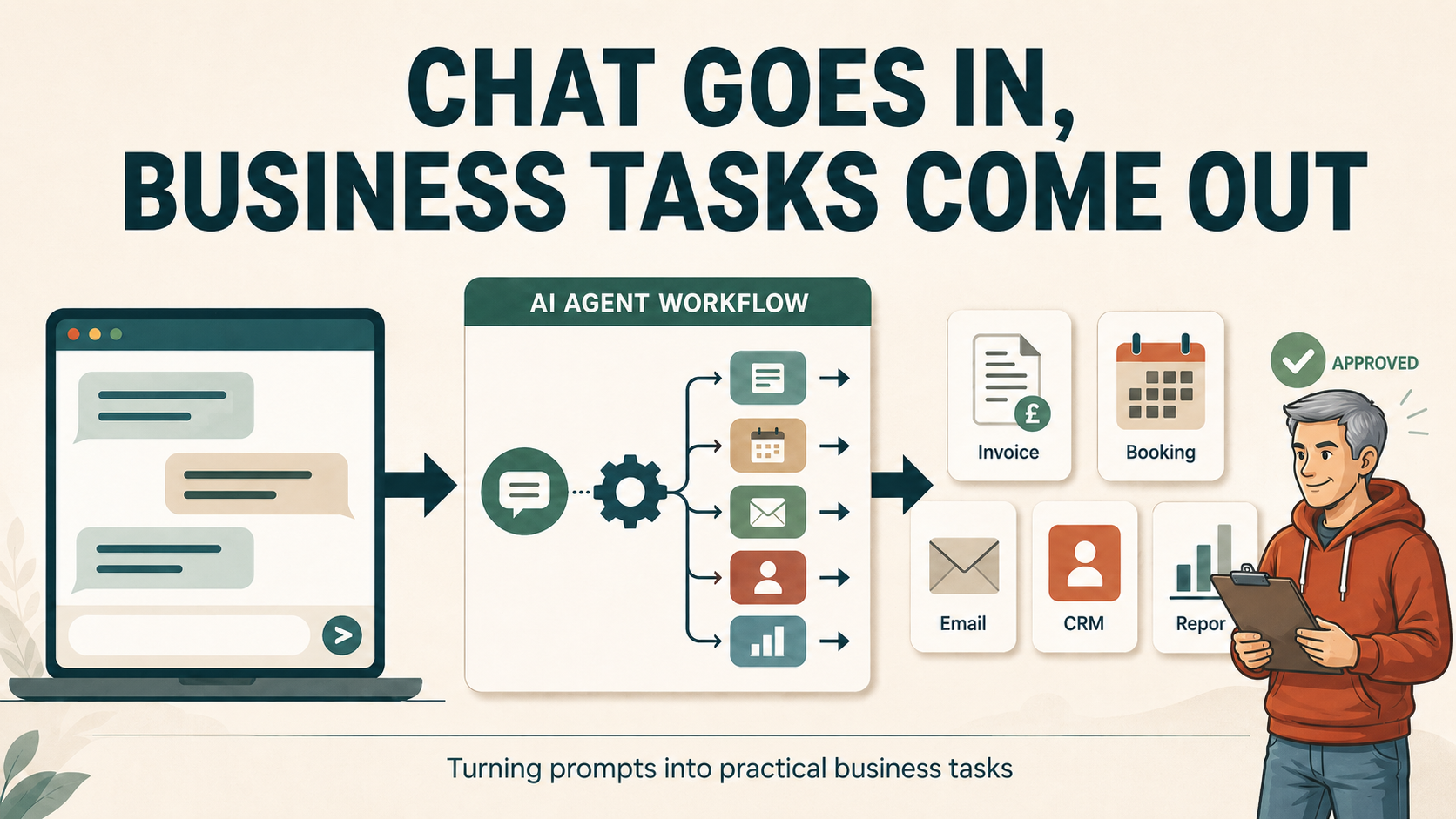
2026 is increasingly being framed as the year AI starts moving from "chatting" to "doing." Not in a fully autonomous sense, but through workflows that can help with invoice chasing, appointment scheduling, customer follow-up, CRM updates and internal reporting.
For most SMEs, the practical opportunity isn't an autonomous AI employee. It's a more capable assistant that can help move work through a process while people remain in control.
⚠️ What hasn't changed
Gartner's 2026 Hype Cycle for Agentic AI places the technology at the "Peak of Inflated Expectations." Its CIO and Technology Executive Survey found only 17% of organisations have deployed AI agents so far, although more than 60% expect to within the next two years.
McKinsey reported in April 2026 that nearly two-thirds of enterprises worldwide have experimented with AI agents, but fewer than 10% have scaled them in a way that delivers tangible value.
The honest truth: agentic AI is real and progressing, but it's still early days. The gap between hype and reality remains significant.
🔧 Where Agentic AI Is Starting to Work for SMEs
The most useful early applications aren't dramatic. They're repetitive, well-defined tasks where the process is clear and the risks can be managed.
Finance and invoicing
Finance is one of the more practical early areas, especially where the task is structured and repeatable. An AI-supported workflow might extract invoice details from emails, match invoices to purchase orders, flag missing information, prepare draft payment reminders, highlight overdue accounts and escalate unusual items.
For SMEs using Xero, QuickBooks or Sage, a realistic starting point is AI that prepares, checks, drafts and flags — while a person approves. AI shouldn't have unchecked authority over payments, supplier changes or financial decisions.
Customer service and enquiry handling
A practical first step here is AI-assisted triage: drafting replies, updating CRM records, routing questions to the right person, summarising previous interactions and escalating anything complex or sensitive.
For service businesses — tradespeople, consultancies, clinics, hospitality and local professional firms — an AI-supported setup that captures enquiries, books appointments or routes messages can be genuinely useful, provided customers can still reach a human when needed. The danger is pretending every customer query can be automated. It can't. A missed nuance or wrong answer can damage trust quickly.
Marketing and content workflows
Many SMEs already use AI to draft social posts, emails and blogs. Agentic AI takes this further by connecting stages of the workflow — reviewing recent customer questions, suggesting topics, drafting a post, creating a publishing checklist and tracking what performed best.
This can be useful for small teams who struggle to publish consistently. But AI can sound confident while producing generic content, unsupported claims or wording that doesn't match your brand. The best model remains: AI drafts, humans edit and approve.
Admin and operations
This is where agentic AI may become quietly valuable. Many SMEs lose time moving information between systems — a customer fills in a form, someone copies it into a CRM, another person creates a folder, someone else sends a confirmation email.
Agent-like workflows can help: creating onboarding tasks for new customers, sending appointment confirmations, chasing missing information, preparing weekly reports, summarising meeting notes and updating internal trackers. The value isn't glamorous. It's fewer dropped balls, better follow-up and less manual admin.
The good, the bad and the ugly
The good: Agentic AI can reduce repetitive admin, speed up customer responses and help small teams do more with limited resources.
The bad: Agents depend on clean data, clear processes and well-connected systems. If your internal process is messy, an AI agent may just make the mess happen faster. Fix the process first.
The ugly: Agents with too much access can make mistakes at scale — emailing the wrong customer, exposing personal data, changing records incorrectly. This is why boundaries, permissions and review matter.
🔐 The Risks SMEs Must Take Seriously
Agentic AI is different from a normal chatbot because it can access your systems, use your data and take actions on your behalf. That makes the risks more practical — and more important to get right before you hand over more responsibility.
Data protection comes first. If an agent can see customer, staff or supplier information, treat it as a UK GDPR issue, not just a tech decision. Before connecting an agent to personal data, you should know what it can access, what lawful basis you're relying on, where the data is stored, whether it's used to train the supplier's models, and who's accountable if something goes wrong. Be especially careful with sensitive data — health, finances, employee records, anything affecting someone's rights. A safe starting point is test data, anonymised data, or draft-only workflows.
Reliability matters more as stakes rise. Agents make mistakes, particularly with unusual situations or unclear instructions. A simple rule: the higher the consequence of an error, the stronger the human approval step.
Watch the costs. Agentic platforms often charge per task, automation or API call. A workflow that's cheap in testing can get expensive at scale. Estimate likely usage and set budget limits before rolling anything out.
Mind the cyber basics. The UK Government's 2025/26 Cyber Security Breaches Survey found only 47% of businesses require two-factor authentication. An agent with broad system access can become another route into your business if permissions are sloppy. Apply the principle of least privilege: give each agent access only to what it strictly needs.
If you sell into the EU, keep an eye on the AI Act. It takes a risk-based approach, with extra requirements for AI used in recruitment, staff monitoring, access to services or financial decisions. Even if it doesn't apply to you today, it signals where governance is heading: clearer records, human oversight, transparency. Keeping a simple inventory of where you use AI is a sensible start.
✅ Your SME Agentic AI Checklist for 2026
You don't need to transform your business overnight. A phased, practical approach is far more likely to deliver real value.
- Get the basics right first. If your team isn't yet using tools like ChatGPT, Copilot or Gemini confidently and safely, start there.
- Map your most repetitive processes. Identify three to five tasks that are rules-based, time-consuming and don't require significant judgement.
- Audit your data quality. Check that the data an agent would rely on is accurate, current and consistently formatted.
- Start narrow and low-risk. Good starting points: appointment confirmations, invoice chasing, basic enquiry routing, internal task creation.
- Set clear boundaries. Decide what the agent can do without approval, what needs sign-off and what data it can access.
- Use draft-only access where possible. Let the agent prepare emails, summaries or updates before a person approves them.
- Review your GDPR position. Update records, supplier checks and privacy information if the agent will process personal data.
- Check whether EU rules may apply. If you sell into the EU or use AI in ways that affect people's rights, check the EU AI Act.
- Check your cyber basics. Two-factor authentication, strong permissions, restricted admin access.
- Measure results. Track time saved, errors reduced, response speed, customer satisfaction.
- Review after 90 days. Decide whether to expand, pause or redesign.
🔮 The Bottom Line
Agentic AI has moved forward in 2026 — but not as fast as the headlines suggest. Gartner places it at the "Peak of Inflated Expectations," and that's a useful warning. There's real progress, but also plenty of overpromising.
For most SMEs, the opportunity isn't fully autonomous AI. It's carefully supervised AI that helps with repeatable work. You don't need a strategy, a budget or a consultant to start — you need one workflow, one owner and ninety days. Pick a repetitive process, set it up in draft-only mode using a tool you already pay for, run it for a quarter, and review. If it works, expand. If it doesn't, you've learned something valuable for less than the cost of a trade show stand.
The SMEs that will benefit most from agentic AI aren't the ones making bold bets now. They're the ones quietly building the habits, processes and confidence to use it well when it matters.
📩 Subscribe to AI for SMEs for free and get plain-English AI updates written for UK small business owners and managers — no jargon, no hype, no scare stories. 👉 Subscribe free at www.aiforsmes.co.uk
Sources
- Gartner's 2026 Hype Cycle for Agentic AI
- McKinsey: Scaling agentic AI with data transformations (April 2026)
- British Chambers of Commerce: Half of SMEs Using AI (March 2026)
- UK Government: AI Opportunities Action Plan: One Year On (January 2026)
- ICO: Guidance on AI and data protection
- UK Government: Cyber Security Breaches Survey 2025/2026