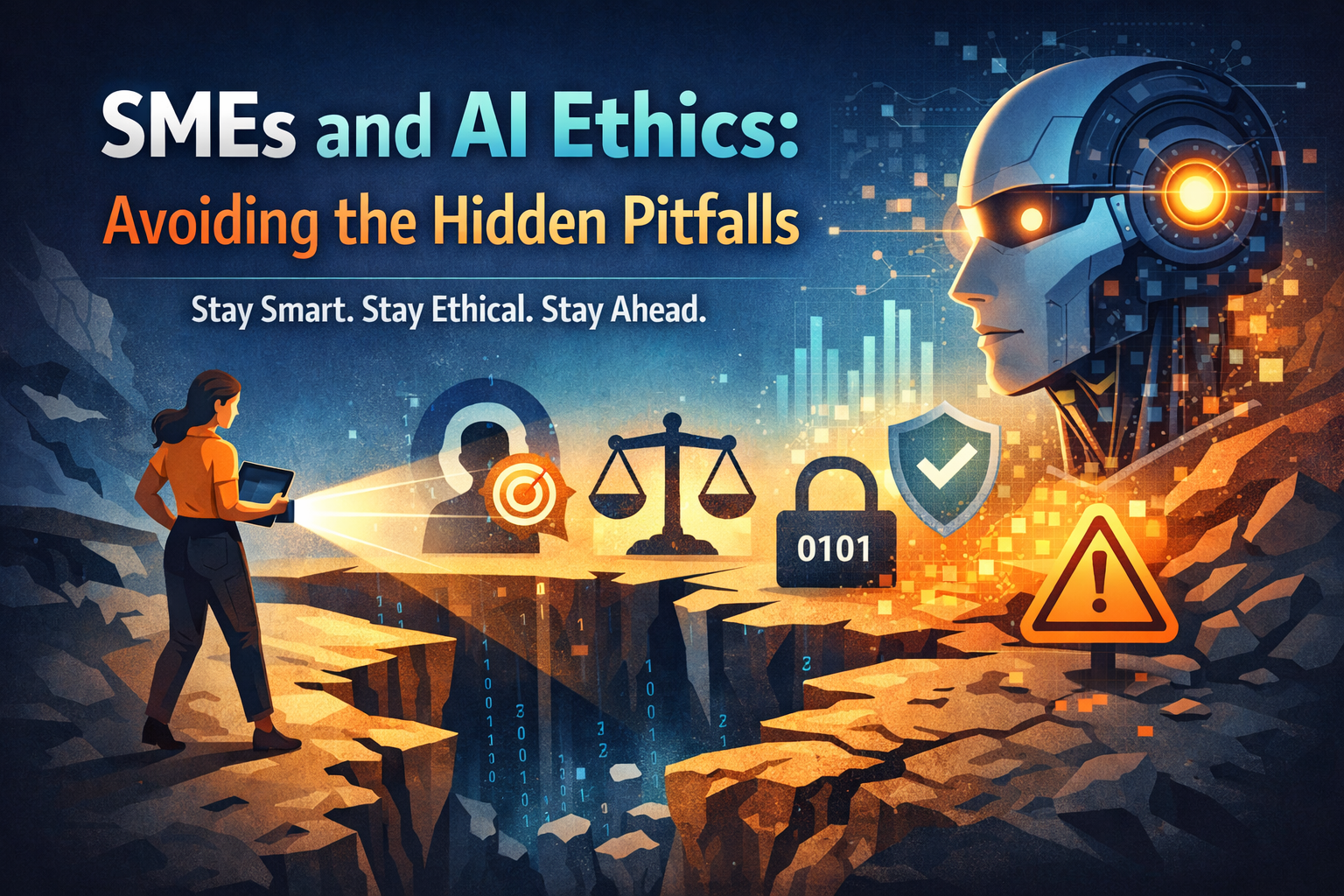
Ethical AI Governance for UK SMEs: Moving Beyond Compliance

In a previous post, Generative AI Risk: Your UK SME Defence Plan, we focused on immediate threats — from data leaks to reputational damage.
This follow-up takes the next step. Managing AI risk isn’t just about avoiding fines; it’s about making ethical choices early, before regulation or a public mistake forces your hand. For UK SMEs, ethical AI governance doesn’t mean bureaucracy. It means clear thinking and sensible oversight that fits your scale.
Why “Legal” Isn’t Enough for AI
Many SME owners are rightly focused on trust. A common concern is:
“Can I trust this AI tool to treat my customers and staff fairly?”
Law sets the floor; ethics raises the bar.
While legal compliance (such as GDPR) is your baseline, ethical governance helps you answer the questions the law hasn’t fully caught up with yet:
- Is this AI fair to our specific customer base?
- Could it disadvantage certain groups without us realising?
- Would we be comfortable explaining this automated decision to a regulator — or a customer?
Ethical AI governance helps businesses act responsibly before harm occurs, not just respond after the fact.
The Reality of AI Failure (and Why It’s Preventable)
Research by Oxethica shows that most AI failures aren’t caused by “evil bots,” but by organisational blind spots. Their review of 106 ethical failures identified three primary modes:
- Privacy intrusion (50%) – Using data without valid consent or beyond its original purpose
- Bias in outputs (31%) – Results that unfairly disadvantage certain groups
- Lack of explainability (14%) – Inability to justify why the AI made a particular decision
The key takeaway for SMEs is reassuring: most AI failures are preventable — often before a tool is fully deployed — if risks are recognised early.
Preventing AI Failure: The Five Pillars of Ethical and Responsible AI
Ethical AI governance in SMEs can be grounded in five simple principles. Each one directly addresses the most common AI failure modes:
- Fairness – Avoid bias by checking data and outcomes across different groups
- Accountability – Assign a named person to own each AI tool
- Transparency – Document what the AI does and why it is used
- Safety – Test for edge cases and unexpected behaviour
- Sustainability – Monitor long-term risks like model drift and data relevance
You don’t need formal policies or committees — just clear answers for each pillar in relation to the AI tools you use.
Where these pillars break down, risk creeps in.
The Real Risk: Organisational Blind Spots
In SMEs, AI risks rarely come from bad intent. They come from assumptions, shortcuts, and unclear ownership that quietly undermine good principles.
Common blind spots include:
- Overtrusting technology — assuming AI is always accurate
- Under-checking outcomes — no one reviews whether results make sense
- No defined owner — responsibility is unclear
- Data quality issues — biased or outdated data skews results
- Unclear escalation — staff don’t know what to do if something feels wrong
- Poor documentation — no record of purpose, risks, or oversight
- Assuming compliance equals safety — legal use doesn’t mean ethical use
These blind spots explain why AI failures occur — and why governance matters even for small teams.
The Trustworthy AI Cycle: A Simple Governance Model for SMEs
You don’t need an enterprise framework to govern AI responsibly. A simplified trustworthy AI cycle is enough:
1. Define Purpose and Oversight
What is this AI for?
Who is responsible if it goes wrong?
Where does a human step in?
Write down the business purpose. Assign a named owner. Identify where humans review or override outputs.
2. Check Data Quality and Permission
Do we have the right to use this data?
Is it representative of real customers and scenarios?
Confirm consent (customer or employee) and review whether the data is current, relevant, and balanced.
3. Set Principles, Not Just KPIs
What does “fair” mean here?
What outcomes would be unacceptable, even if efficient?
Agree values and guardrails — not just performance targets.
4. Test and Document
Run small tests using real scenarios to surface unusual or unfair results.
Keep a simple log: purpose, risks, assumptions, and oversight points.
5. Monitor Over Time
AI isn’t “set and forget.” Models drift, data changes, and risks evolve.
Set a review schedule and assign someone to spot-check outcomes regularly.
AI Tool Governance: What UK SMEs Must Ask Vendors
Most SMEs will buy AI tools rather than build them — and that’s perfectly sensible.
But purchasing AI does not remove responsibility.
When using third-party AI tools:
- Ask how bias is tested and monitored
- Ask what transparency or audit options exist
- Understand where liability sits if something goes wrong
If you build or customise AI internally:
- You gain more control — and more accountability
- Governance must be embedded from day one
Either way, ethics and governance are strategic business decisions, not technical afterthoughts.
Embedding AI Governance Into Existing SME Processes
The most effective approach is to integrate AI governance into what you already do — not create a separate structure.
Practical actions include:
- Adding AI risks to your existing risk register
- Assigning oversight to an existing role (e.g. operations or compliance lead)
- Using a short pre-use checklist for new AI tools
- Agreeing clear escalation paths when something feels off
Many SMEs already manage financial, health and safety, or data risks this way. AI should be no different.
Why Ethical AI Governance Builds Trust and Long-Term Value
Customers, employees, and partners increasingly care how AI is used — not just whether it saves money.
Ethical AI governance:
- Builds trust with customers
- Protects staff confidence and morale
- Reduces regulatory and reputational risk
- Future-proofs your business as AI rules evolve
Trust is not a “soft” issue. It directly affects adoption, value, and long-term outcomes.
A Practical First Step for SME Owners: The AI Governance One-Pager
You don’t need to solve AI ethics overnight. You also don’t need a policy manual or a legal team.
One page is enough to bring clarity, accountability, and control.
Before using (or continuing to use) any AI tool, create a one-page AI governance summary that answers:
- Purpose – What specific task does this tool solve?
- Data & Privacy – What data is used, and do we have customer or employee consent?
- Human-in-the-Loop – Who is the named owner, and when does a human review outputs?
- Boundary Lines – What outcomes would cause us to stop using this tool immediately?
- Red Button Protocol – Who do staff alert if the AI produces something biased, offensive, or wrong?
- Bias Check – How do we ensure this doesn’t disadvantage a specific group?
- Review Cycle – When is the next health check?
If you can’t explain how an AI tool is governed on one page, you don’t yet have control over it.
This single step will put your business ahead of most SMEs — and firmly on the right side of trust, accountability, and future regulation.
📬 Stay Updated
For more practical AI insights and to keep up with the world of AI, sign up for free at www.aiforsmes.co.uk