The SME Leader’s Guide to the UK Government’s AI Skills Report

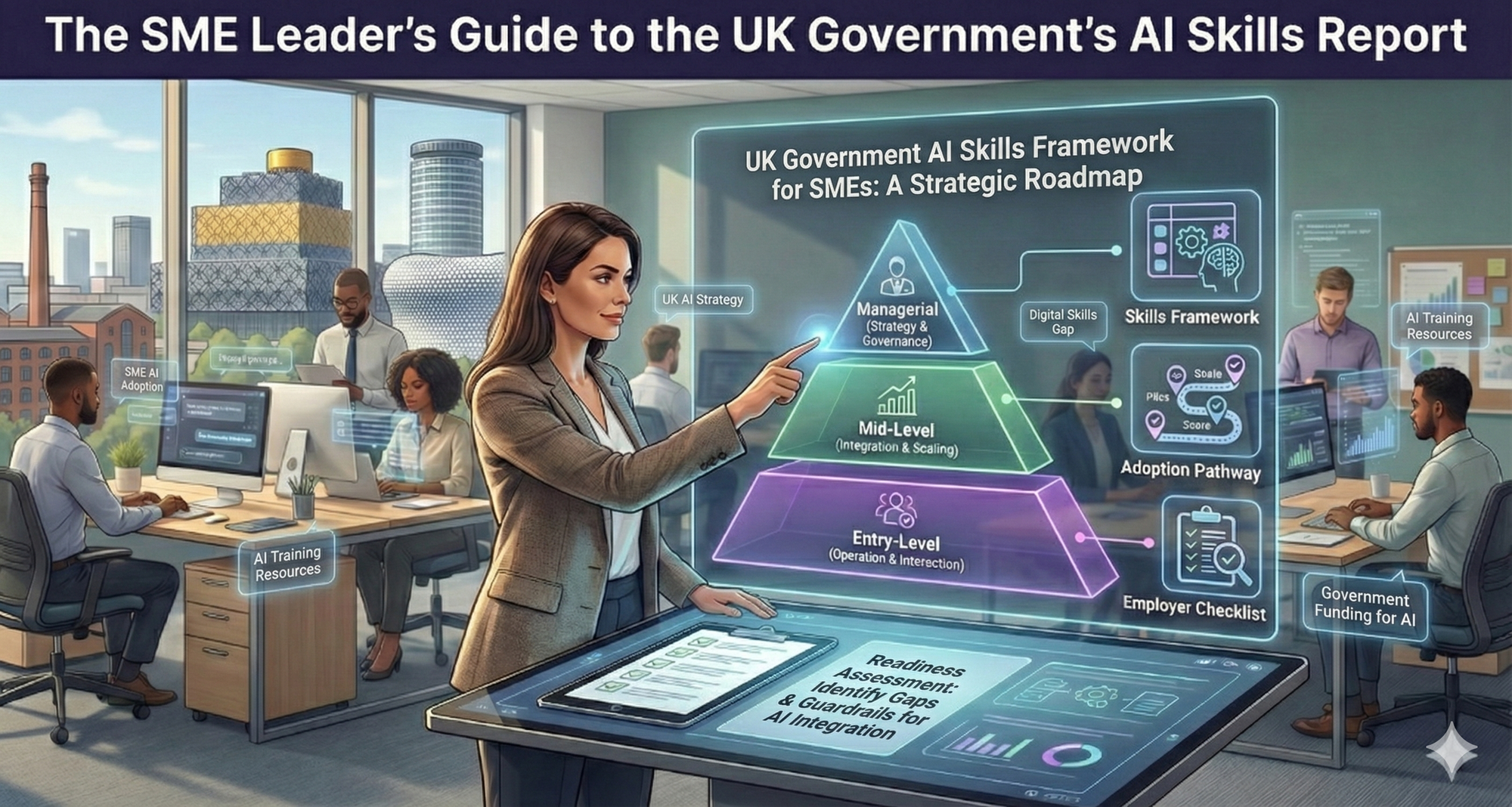
AI is moving from "interesting experiment" to everyday advantage. But for most UK SMEs, the real blocker isn’t enthusiasm — it’s knowing what to do first, and how to build AI skills without overwhelming people or budgets.
The UK Government's AI Skills for the UK Workforce report tackles exactly that challenge. It introduces practical tools to help employers define AI skills needs clearly, plan training by job level, and adopt AI responsibly.
This guide turns those tools into a step-by-step plan tailored for SME leaders, ready to put into action in 2026.
What the AI Skills Report Means for SME Capability Planning
The report's central message is clear: AI skills development is being held back by uncertainty and fragmentation, especially among smaller organisations.
Many SMEs don’t yet have a clear idea of what AI skills their workforce needs. That makes training patchy and slows adoption.
Instead of asking, “Should we use AI?” SME leaders should ask:
"Which skills, for which roles, in which order?"
3 Government Tools SMEs Can Use to Build an AI Skills Plan
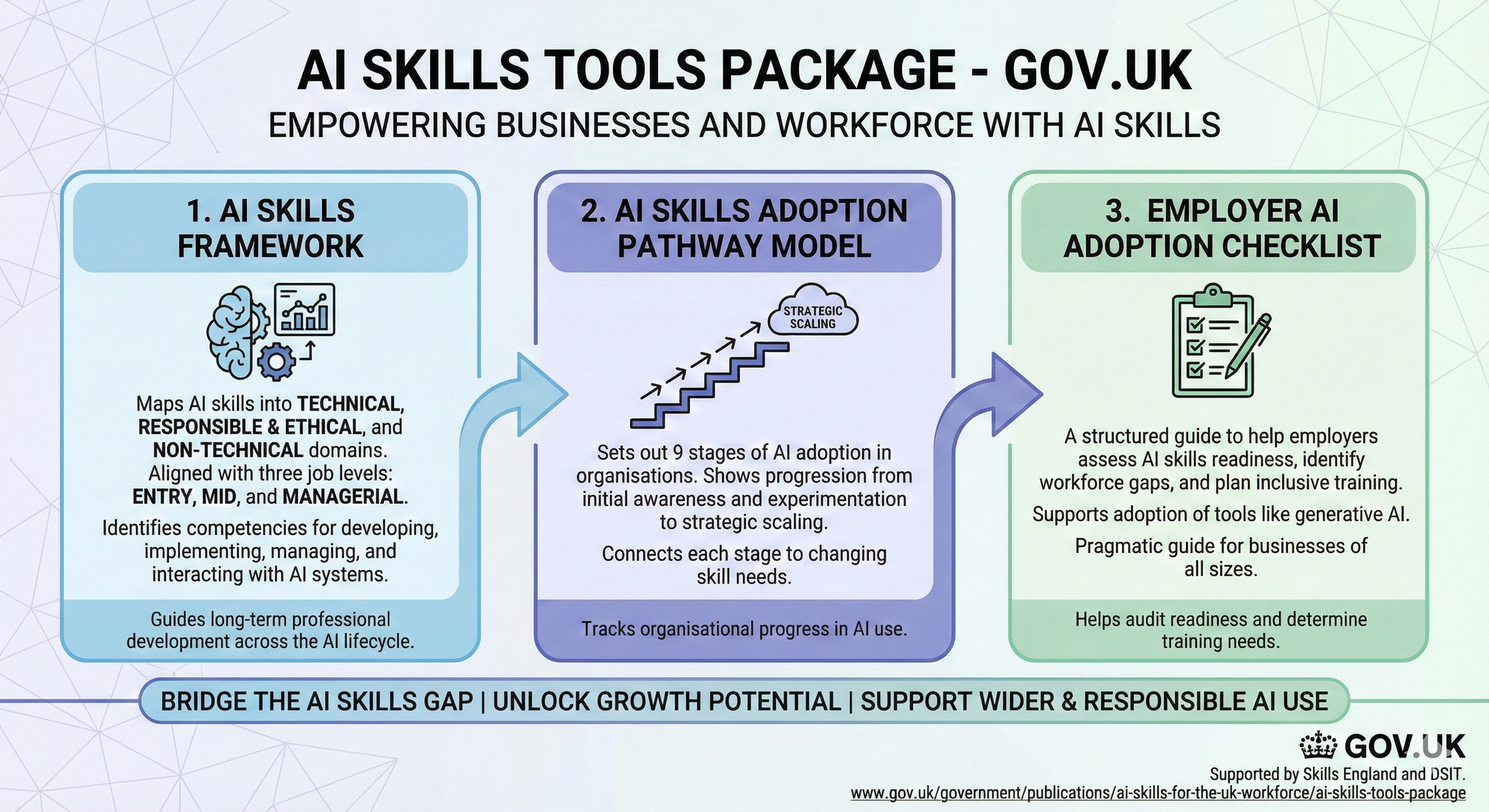
The report introduces three interlinked tools:
1. AI Skills Framework: What skills do we need?
Outlines technical, responsible, and non-technical AI skills. Aligns them to different job levels (entry, mid, managerial).
2. AI Skills Adoption Pathway Model: When do we need them?
Shows how AI skills needs evolve as organisations move from experimenting with AI to fully integrating it.
3. Employer AI Adoption Checklist: How ready are we?
A structured self-assessment to highlight your current capabilities and plan responsible upskilling.
Used together, these give SMEs something rare with new tech: a sensible order of operations.
How UK SMEs Can Use the AI Skills Framework: A Step-by-Step Plan
Step 1: Identify One High-Value, Low-Risk Outcome
Start with business value, not tools.
Example outcomes:
- Reduce admin time
- Improve customer response speed
- Increase consistency in messaging
- Improve internal reporting accuracy
This aligns AI with real problems, not hype.
Step 2: Choose One Simple, Low-Risk Use Case
Select a task that’s easy to contain and doesn’t need sensitive data.
Good starting points:
- Drafting internal documents
- Summarising meeting notes
- First-draft customer messages (with human review)
- Generating basic reports or templates
Step 3: Place Yourself on the AI Adoption Pathway
If your AI use is informal or inconsistent, you’re likely at the early stage.
Initial focus should be on:
- Baseline AI literacy
- Safe use practices
- Basic evaluation of outputs
Step 4: Run a Rapid Readiness Check
Using the Employer Checklist approach:
- What are we ready to trial?
- What should we avoid for now?
- What skill gaps are most urgent?
Step 5: Map Skills to Roles Using the Framework
Avoid the classic SME mistake of sending everyone on the same course. Tailor skills to job level:
For each use case, define what each role needs:
- Entry-level
- Mid-level
- Managerial
Step 6: Set Minimum Guardrails Before Scaling
Start with a lightweight, one-page AI use policy covering:
- What data must never be entered into AI tools
- When human review is required
- Who owns each AI-enabled process
- Other areas to consider
Example: 3-Line SME AI Use Policy
- Never paste client personal or financial data into public tools
- Always review AI outputs before sending externally
- Use only pre-approved AI tools and workflows
What "Managerial AI Capability" Looks Like for SMEs
The report aims to help leaders confidently oversee AI adoption.
In SME terms, managerial AI capability means being able to:
- Identify scalable use cases
- Set rules for safe and effective use
- Assign accountability
- Connect AI activity to clear business outcomes (time saved, errors reduced, leads increased)
Think of it as smart operational leadership — not "becoming an AI engineer."
How to plan and execute for mid-level staff
Why Mid-Level Roles Matter
These roles turn leadership intent into everyday practice. They are vital for safe, consistent AI use.
Practical SME Steps for Mid-Level Roles
- Give ownership of one workflow examples:
- Customer service replies
- Proposal writing
- Scheduling and rota planning
- Internal reporting
- Provide a basic operating kit include:
- List of approved AI tools
- Prompt templates
- Quality checklists
- Banned data types
- Human review triggers
- Standardise, don’t reinvent encourage:
- Shared prompts and templates
- Consistent tone and formatting
- Simple workflow notes
- Set up a 30-minute bi-weekly check-in ask:
- Where did AI save time?
- Where did it cause problems?
- What changes improved outcomes?
- Make them internal AI coaches They don’t need to be experts — just confident translators who help others use tools safely.
Building Entry-Level AI Confidence Without Risk
What the Report Recommends
Entry-level staff should gain confidence using AI in narrow, supervised ways.
5-Step Practical Rollout
- Start with low-risk, repeatable tasks
- Summarising meetings
- Turning notes into emails
- Drafting FAQs
- Teach a simple CRAFT prompt structure use this pattern:
- C – Context (Background)Provide who, what, where, and why.Helps the AI understand the situation and purpose.
- R – Role (Perspective)Set the expert identity or viewpoint the AI should take.
- A – Action (Task)Tell the AI exactly what to do (write, summarise, analyse, etc.).
- F – Format (Output)Say how you want the information presented (bullet points, table, report, etc.).
- T – Tweaks (Refinement)Add constraints like tone, length, style, or examples.
- Introduce a 60-second quality check
- Is it accurate?
- Is the tone appropriate?
- Could this mislead a customer?
- Should a manager review it?
- Make boundaries crystal clear Include in your one-page AI policy:
- What content is off-limits
- Which tasks are approved
- When human sign-off is needed
- Celebrate good usage When someone uses AI well:
- Share the prompt
- Show before/after
- Explain why it was safe and effective
A 30-Day AI Skills Rollout Plan for UK SMEs
Week 1: Leadership Clarity
- Choose a low-risk use case
- Set simple guardrails
- Use Checklist mindset to spot gaps
Week 2: Role Mapping
- Define skills needed at each level (entry, mid, managerial) using the Framework
Week 3: Controlled Pilot
- Entry-level: First drafts
- Mid-level: Standardise prompts and review
- Managers: Oversee risk and outcomes
Week 4: Scale One Notch
- Capture best prompts
- Update rules
- Add one more use case
Free AI Training Resources SMEs Can Use Today
The Government’s AI Skills Report highlights a major challenge for SMEs: the UK’s training ecosystem is fragmented, and employers often don’t know where to start. The good news is that high-quality, free AI literacy training is now more accessible than ever — and ideal for helping teams build confidence without increasing budgets.
Below are trusted, practical training resources you can safely recommend to your staff as part of your early AI skills rollout.
1. OpenAI Academy (Free AI Fundamentals Training)
OpenAI Academy offers structured, bite-sized learning paths covering AI basics, prompt skills, safe use, and practical applications for everyday work.
It’s designed for non-technical users and is a great entry point for SMEs who want staff to build confidence quickly.
Good for:
- Baseline AI literacy
- Understanding how tools like ChatGPT work
- Safe and responsible use practices
- Quick, self-paced learning
2. Google – Learn AI Skills
Google’s free AI learning hub provides practical, easy-to-follow training for beginners. It includes short courses, videos, mini-projects, and productivity tutorials that help staff understand how to use AI tools in real work scenarios.
Good for:
- Beginners with no prior AI experience
- Understanding real-world AI use cases
- Building productivity workflows
- Learning safe use and responsible principles
3. OpenLearn, Microsoft, IBM & Other Public Platforms
There are several additional free resources that complement the Government’s AI Skills Framework, including:
- Open University – OpenLearn: Introduction to AI
- Microsoft AI Skills Initiative (free foundational AI courses)
- IBM SkillsBuild (entry and intermediate AI pathways)
These programmes are recognised, accessible, and suitable for building entry-to-mid-level AI capability across SME teams.
Why These Free Resources Matter for SMEs
You don’t need a formal training budget or a complex L&D programme to begin building AI capability. What your workforce needs in the early stages is:
- confidence
- safe-use habits
- practical exposure to simple tools
- clarity on what’s approved and what isn’t
Free, well-designed training helps employees gain these foundations while you focus on building the policies, workflows, and role-based capabilities recommended by the Government report.
The Takeaway for SME Leaders
The Government's AI Skills Report helps SMEs cut through the noise and build practical, tailored capability.
If you remember one thing: Start with managerial clarity. Then build role-based skills for mid and entry-level staff.
That’s how you turn AI curiosity into confident, scalable adoption — without turning your training plan into a second full-time job.
AI capability isn’t built through massive transformations — it’s built through small, well-guided steps. With the UK Government’s AI Skills Report providing a clear structure, 2026 can be the year your SME moves from experimentation to confident, responsible AI adoption. If you found this guide useful and want more practical, jargon-free insights tailored for UK small businesses, subscribe for free at www.aiforsmes.co.uk. You’ll get weekly tips, templates, and real SME examples to help you stay ahead without the overwhelm.