The Data Question Every SME Owner Now Faces

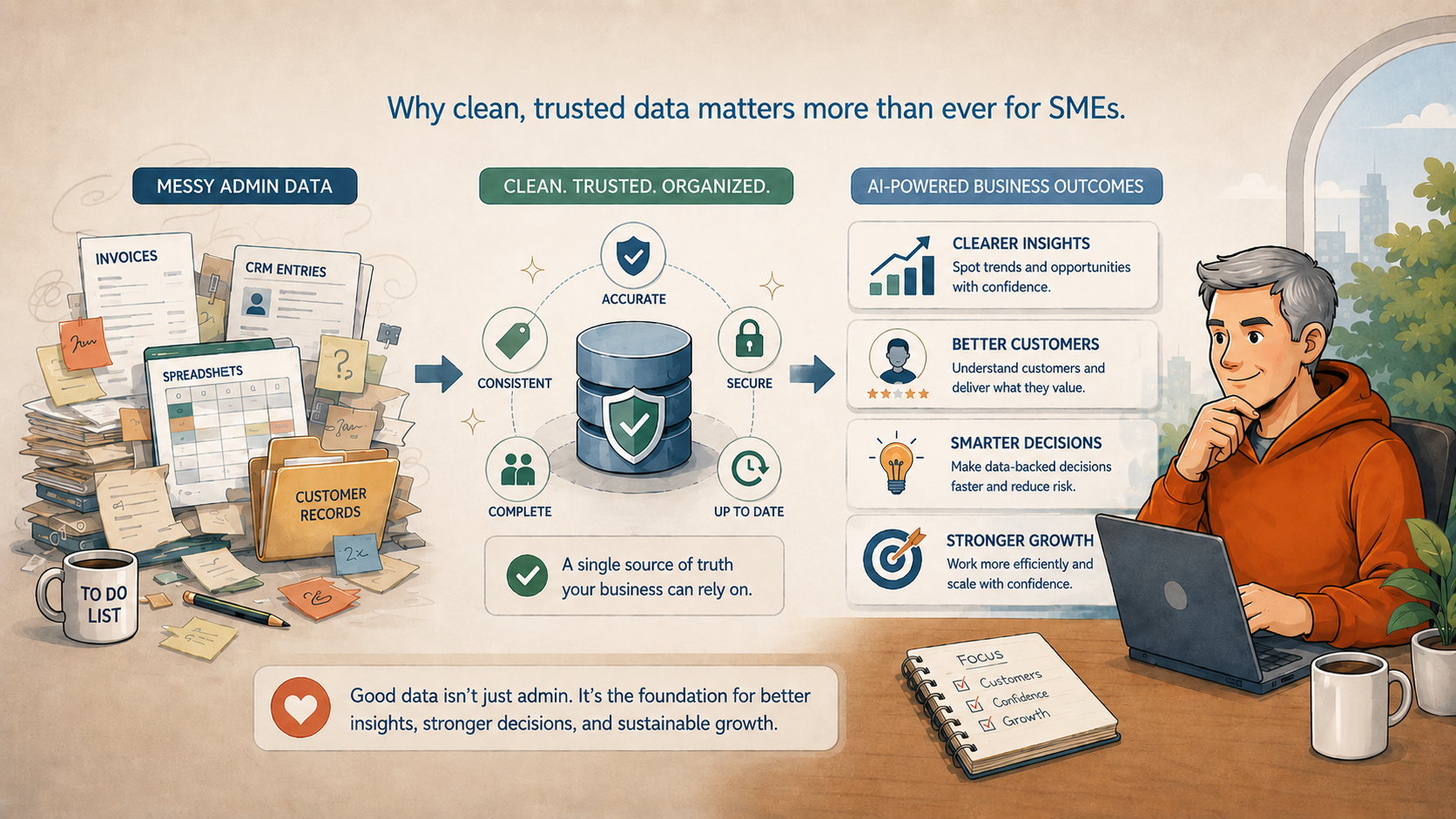
Most small businesses run on data that grew up in pieces. Customer details live in a CRM that's half used, a spreadsheet someone built in 2021, and a folder of old emails. Invoices sit as scanned PDFs. Pricing lives in a file called pricing_FINAL_USE_THIS.xlsx — right next to pricing_final_v2.xlsx.
For years, this was an annoyance you could live with. People knew where things were, more or less, and the business muddled through. But two things have changed.
First, the cost of muddling through has quietly grown. Think how much of your team's week goes on re-keying figures, chasing information across systems, and reconciling numbers that should already match — an admin tax paid every month.
Second, AI has stopped being a fringe experiment: research from the British Chambers of Commerce found that more than half of UK firms (54%) are now actively using AI, up from around a third just a year earlier. And AI doesn't muddle through. It hides the mess — you get confident, polished answers whether the underlying data is sound or not, with no easy way to tell the difference.
That second point is the one catching businesses out.
Why Messy Data Breaks AI
There's a common assumption that AI will somehow tidy things up — point it at the chaos and let it work things out. In practice, the opposite happens. AI tools work best when they can find the right information, in a consistent format, with a clear source of truth. When they can't, they guess. And they guess confidently.
Businesses that hit this problem know how serious it is. The government's own AI adoption research identifies fragmented, unstructured and siloed data as a technical barrier to deploying AI effectively — and among the businesses who face it, seven in ten rate it a significant one. One firm in the study described the problem perfectly: too many systems that don't link together, so nothing can see the true picture of the business.
Three typical scenarios show how this plays out.
The customer who appears four times. A business has the same client recorded as "ABC Engineering Ltd" in the CRM, "A.B.C Engineering" in a spreadsheet, "ABC Eng" on invoices, and "Andrew at ABC" in email. Ask a tool to analyse which customers have reduced their orders this year, and unless those records have been matched up, it can treat them as four separate companies — and confidently tell you a valuable customer is barely worth keeping.
The invoices nobody can read. Years of supplier invoices stored as scanned PDFs, some without selectable text, some with handwritten notes. Ask which suppliers have raised prices most, and the AI may miss what it can't read and produce a confident-looking answer based on the half it could. "Supplier X is up 4%" looks precise and is quietly wrong.
The quote built on old prices. Ask an AI assistant to draft a quote "using our current pricing," and with no rule defining which file is current, it may pull last year's price list and produce a polished, professional, incorrect proposal.
In each case, the problem isn't the AI. It's that the business never decided what "the right answer" looks like in its own data. Bad data in, bad AI out — only now the bad output arrives faster and looks more convincing.
The Good News: You Don't Need Perfect Data
Here's where many SME owners get stuck. They look at the mess and picture what fixing it must involve: bringing in an IT consultancy, a quote with an eye-watering day rate, months of disruption, and staff pulled off the day job to "sort the data out". So it goes on the someday list, next to the website refresh — and stays there.
But the goal isn't a perfect enterprise data estate. It's a simple, trusted working layer — just enough structure that the business (and any AI tool) can answer its most important questions reliably. That's achievable in months, mostly with tools you already own.
Start with one question, not all your data. "Clean everything" is a project that never finishes. Instead, pick one question that matters: Which customers are most profitable? Which invoices are overdue? Which suppliers are raising prices? Then map only the data needed to answer it. Anything that doesn't help, park for now.
Agree a few simple standards. Before buying any tools, set some basic rules: one way of writing customer names, one date format, one unique ID for customers and invoices, one named owner for each key dataset, and one rule for which file version is "live". None of this costs money. All of it pays back immediately.
Build a modest source of truth. This doesn't need to be a data warehouse. For most SMEs, the first version is a well-structured Excel workbook, a tidy shared folder, or a properly maintained CRM — somewhere the agreed, current version of customer, invoice and project data actually lives. Free and low-cost tools like Excel's Power Query or OpenRefine can do the heavy lifting of merging and de-duplicating.
Test before you trust. Before connecting any AI tool, run simple checks. Are there duplicates? Do CRM figures match invoice figures? Are old files archived? And one check that's easy to forget: should everyone who'll use the AI see everything in the source data? If salary details or personal information sit in the folders you're connecting, an AI tool can surface them to anyone who asks — sort access permissions before you connect, not after.
Then run a spot check: pick five questions you already know the answers to — "What did Customer X spend with us last year?", "How many invoices are overdue?", "What's our live price for Product Y?" — and see whether your cleaned data agrees. A useful rule of thumb: if a human can't trust the dataset, an AI shouldn't be connected to it yet.
A Realistic Pace
A sensible rhythm for a small business:
- Month one: map your systems and pick your first question.
- Month two: clean that one dataset and set your standards.
- Month three: pilot AI on the cleaned data in a narrow, low-risk way — always requiring it to cite its sources.
- Month four onwards: expand carefully, keeping a human in the loop for anything customer-facing or financial.
That's it. Not a transformation programme. Small, deliberate steps — each one useful on its own, even if you never touch AI at all.
The Real Opportunity
The businesses getting genuine value from AI aren't the ones with the biggest budgets. They're the ones who cleaned the small amount of data that matters most, structured it properly, and then put AI on top of something they already trusted. That approach is cheaper, safer, and far more likely to work than laying expensive technology over chaos.
The mess in your data didn't appear overnight, and it won't disappear overnight either. But you can make a meaningful start this month — with one question, one dataset, and a few simple rules.
If you'd like more plain-English guidance on getting your business ready for AI — without the hype or the jargon — you'll find practical articles and a free monthly newsletter at www.aiforsmes.co.uk.