AI for UK SMEs in 2026: What Has Actually Changed?

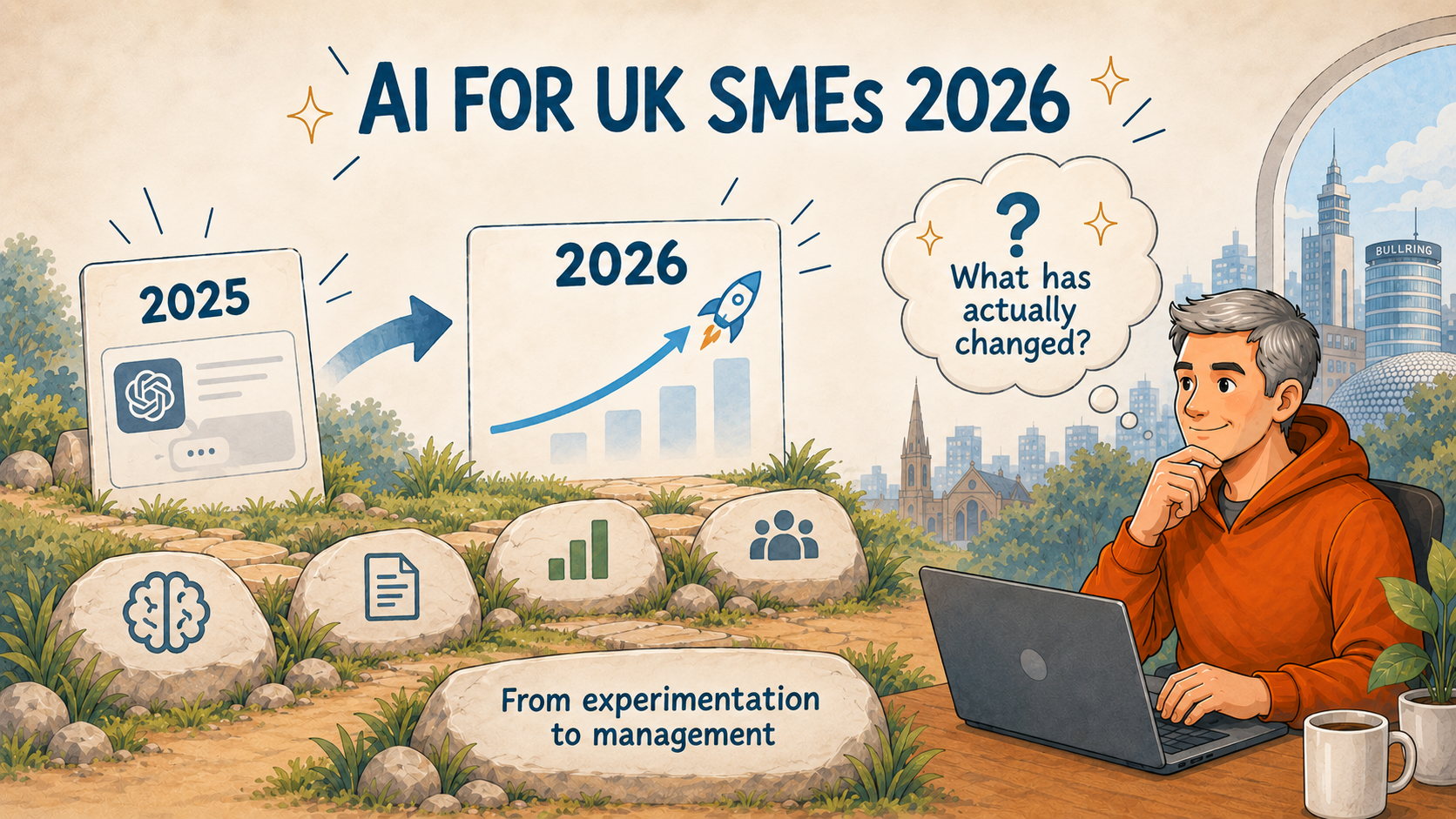
AI has changed dramatically since early 2025. The more interesting question is how much UK SMEs have actually changed with it.
In April 2025, following an AI workshop I had delivered earlier that year, I wrote AI for UK SMEs 2025: What to Know and Do Now.
The aim was fairly simple. Cut through some of the noise around artificial intelligence and give SME owners a practical starting point.
At the time, my advice was to understand what AI could realistically do, start with a business problem rather than the latest tool, run small pilots, measure the results, look after your data and always keep a human in the loop.
I also looked ahead at what might come next: cheaper and more accessible AI, more AI built into everyday software, low-code tools and the emergence of AI agents capable of completing multi-step tasks.
A lot has happened since.
We have had more powerful models, reasoning tools, AI research capabilities, image, video and voice generation, AI embedded into workplace software and, perhaps most noticeably, the rise of AI agents.
If you followed the technology headlines alone, you could be forgiven for thinking businesses had been completely transformed.
But have they?
I went back to what I wrote in April 2025 and compared it with what the evidence is telling us in September 2026.
My conclusion is slightly different from the story you might get from the AI headlines.
AI capability has moved incredibly quickly. AI use has grown significantly. But organisational change inside many businesses has moved much more slowly.
And for SMEs, that matters.
AI use has certainly moved into the mainstream
There is little doubt that more businesses are now using AI.
The Office for National Statistics (ONS) publication Artificial Intelligence in UK Businesses: 2023 to 2026, based on its Business Insights and Conditions Survey, found that the proportion of UK businesses with 10 or more employees reporting use of at least one AI technology increased from around 12% in late 2023 to around 35% by June 2026.
Among businesses with fewer than 10 employees, 28% reported using at least one AI technology.
ONS also found something else worth noting.
More than half of employees surveyed, 55%, said they used AI for work or education. ONS suggested that part of the difference between employee use and formal business adoption may reflect people using AI tools independently rather than as part of an organisation-wide approach.
That feels important.
When we talk about "AI adoption", we can be talking about very different things.
Someone asking ChatGPT to improve an email is using AI. So is a business with AI connected into its CRM and workflows.
But those are clearly very different levels of adoption.
Using AI is not the same as integrating AI into how the business actually operates.
The technology has moved faster than business adoption
This may be the biggest difference between the AI conversation in early 2025 and September 2026.
The capability available to an ordinary business user has improved enormously.
AI can now work with much more than a simple text prompt. It can analyse documents and spreadsheets, work across large amounts of information, understand images and audio, undertake research, write code, use tools and increasingly carry out multiple steps towards completing a task.
For SMEs, accessing many of these capabilities no longer requires building an AI system or employing specialist developers. Much of it is available through relatively inexpensive subscriptions or through software the business already uses.
But greater capability has not automatically produced deeper adoption.
The same ONS analysis found that although the number of businesses using AI had increased substantially, the average number of AI technologies used by adopting businesses had moved only from around 1.4 to 1.6 since late 2023.
Among businesses with 10 or more employees already using AI, only 10% described their use as extensive. ONS concluded that adoption remained relatively shallow and that the transformative impact on businesses had so far been limited.
That is perhaps one of the most useful reality checks in all the research.
AI adoption has broadened much faster than it has deepened.
Generative AI has become the obvious entry point
Another thing that has become clearer since I wrote the original article is how most businesses encounter AI.
The Department for Science, Innovation and Technology (DSIT) published AI Adoption Research in January 2026, based on research with 3,500 UK businesses employing five or more people.
Among businesses already using AI, 85% were using natural language processing and text generation.
There is an important qualification here.
Although the report was published in 2026, its survey fieldwork was undertaken between February and May 2025, so it should not be treated as a snapshot of AI adoption in 2026.
Nevertheless, it illustrates something we can see around us.
For many SMEs, AI has not arrived as a major technology implementation project.
It has arrived through a conversation box.
That accessibility has been hugely important.
But I think the skills needed to use AI well are changing too.
AI skills are becoming less about prompting and more about judgement
In 2023, 2024 and much of 2025, there was enormous attention on prompting.
And prompting still matters. Being clear about what you want, providing useful instructions and giving AI relevant information all improve the result.
But I increasingly think "prompt engineering" is too narrow a way of thinking about AI skills for most businesses.
What matters now is whether people can:
- frame the business problem properly;
- provide useful context;
- recognise what information the AI needs;
- use reliable source material;
- challenge and verify the answer;
- protect confidential or personal information;
- understand where the technology is weak;
- recognise when human expertise is necessary.
In other words:
AI literacy is increasingly about judgement rather than learning a collection of clever prompts.
This becomes even more important as AI moves beyond giving us answers and starts helping us complete work.
What about AI agents?
This was one of the areas I mentioned in my 2025 article.
At the time, I described simple agents capable of carrying out multi-step tasks as something SMEs should expect to see becoming more common.
That has certainly happened at the technology and vendor level.
An AI system can increasingly be asked not simply to answer a question, but to research something, work through information, use tools and perform several stages of a task.
But agents are also one of the clearest examples of capability running ahead of widespread business adoption.
The Department for Science, Innovation and Technology's (DSIT) AI Adoption Research, based on fieldwork carried out between February and May 2025, found agentic AI was the least-used type of AI among adopters at that point, at 7%.
That makes the figure useful as a baseline rather than a measure of today's adoption.
Since then, agent capability and vendor activity have moved quickly, but good evidence on widespread SME deployment is still much thinner.
So the important point is not that adoption remains at 7%. It is that agents illustrate the wider gap between what the technology can now do and how far businesses have actually integrated it into everyday work.
There is still an important distinction between seeing an impressive agent demonstration and having an agent reliably carry out important work inside a business.
For SMEs, I think a sensible progression is:
Ask → Assist → Automate → Delegate
Ask: Let AI answer questions or help you explore an issue.
Assist: Use it alongside an employee to complete a task.
Automate: Allow it to handle well-understood, repeatable parts of a workflow.
Delegate: Give it responsibility for completing a multi-step task using tools or systems.
The further along that path you move, the more important controls and human oversight become.
AI is becoming part of the software you already own
Another prediction from the original article was that AI would increasingly become integrated into normal business software.
That has happened.
AI capabilities now appear across productivity suites, CRM systems, finance software, customer service platforms, ecommerce tools, marketing systems and many other business applications.
But once again, we need to separate availability from integration.
DSIT's UK Business Data Survey 2026 found that, among businesses already using AI, only 21% said their AI tools were integrated into existing business systems.
Integration varied considerably by business size. The figure was 27% for micro businesses, 31% for small businesses, 31% for medium-sized businesses and 57% for large businesses. Sole traders were lower still, at 18%.
The quantitative survey was conducted between October 2025 and January 2026, so it provides a useful picture of business practice around the start of this year.
This suggests that for many businesses, AI is still being used alongside existing processes rather than being fully integrated into them.
For SMEs, however, there is a practical opportunity here.
Before buying another AI tool, find out what AI capability already exists inside the software you are paying for.
You may already have useful functionality sitting inside Microsoft 365, Google Workspace, your CRM, accounting system, ecommerce platform or other software.
The lowest-cost AI opportunity might simply be getting more from what you already have.
Productivity is becoming clearer. ROI is not.
In the original article I encouraged SMEs to measure return on investment rather than adopting AI because everyone else seemed to be doing it.
I think that advice is even more important today.
There is increasingly credible evidence that AI can make particular tasks quicker and improve productivity.
DSIT's AI Adoption Research found that 75% of AI-adopting businesses reported improved workforce productivity and 57% reported new or improved processes or operations.
But the same research found that 77% had not seen a change in revenue since adopting AI. Only 12% reported an increase.
These were self-reported results, which is an important limitation, but they still make an interesting point.
Saving time is not automatically the same as creating financial value.
Imagine AI saves an employee five hours each month.
That sounds positive.
But what happens to those five hours?
If they simply disappear into other low-value activity, the financial impact may be negligible.
If those hours are redirected towards speaking to customers, generating sales, improving service, increasing capacity or avoiding outsourced costs, the commercial benefit becomes much clearer.
The question SMEs increasingly need to ask is not simply:
"Did AI save us time?"
It is:
"What did we do with the time it saved?"
AI is changing tasks faster than jobs
Another area where the headlines have often moved faster than the evidence is employment.
The picture may change substantially over the coming years, particularly as systems become capable of completing longer and more complex tasks.
But the evidence so far points much more towards AI changing tasks than wholesale replacement of people across SMEs.
ONS found that improving existing business operations was the most common use of AI among larger businesses and that increased adoption had not yet translated into widespread changes in overall workforce headcount.
That does not tell us what will happen in five years.
It tells us what the evidence supports today.
For an SME manager in September 2026, the more immediate workforce question is probably not:
"Which jobs can AI remove?"
but:
"How can our people use AI to do useful work better, and what skills do they now need?"
Governance has become more practical, not less
I also wrote about privacy, security, regulation, hallucinations and keeping humans involved in 2025.
None of those concerns have gone away.
If anything, they have become more practical as everyday AI use has spread.
The Organisation for Economic Co-operation and Development (OECD) report Generative AI and the SME Workforce: New Survey Evidence looked specifically at generative AI use among SMEs.
It found that a third or fewer of SMEs using generative AI had taken measures such as staff training, establishing internal guidelines or researching relevant legal and regulatory issues.
That gap matters.
If employees are already using AI, waiting until the business has a formal "AI project" before thinking about governance is probably too late.
Most SMEs do not need to start with a 50-page AI policy.
They do need some basic answers.
Which AI tools can staff use?
What information should never be entered into them?
What outputs need checking?
Where must a human approve the result?
Who remains responsible for decisions?
That is governance in practical SME terms.
Human oversight also remains very much part of current business practice.
DSIT's AI Adoption Research found 84% of AI-using businesses applied at least some human input or checking to AI-generated outputs or decisions, with 67% reporting significant checking. Only 2% reported no human checking at all.
My 2025 advice to keep a human in the loop therefore survives pretty well.
And what about AGI?
In the original article I briefly explained Artificial General Intelligence, or AGI, and Artificial Superintelligence, or ASI, mainly to separate those concepts from the practical AI available to SMEs.
I would still not suggest an SME owner spends much time trying to predict when AGI will arrive.
But the boundary is less comfortable than it was.
Today's systems can be remarkably capable, but they are not consistently reliable across every task.
Capabilities that would once have sounded much closer to "general" intelligence are beginning to appear in everyday tools.
Whether somebody eventually declares that we have achieved AGI is probably less useful to an SME than watching what AI can reliably do that it could not do six months earlier.
That is where the commercial implications will appear first.
So, what has actually changed?
Looking back, I am struck by how much the technology has changed and how little I would change some of the fundamental advice from April 2025.
Start with the problem, not the tool.
Still right.
Start small and test.
Still right.
Define what success looks like before you implement something.
Still right.
Get your data into reasonable shape.
Probably even more important.
Do not blindly trust AI output.
Definitely still right.
Keep humans involved in important decisions.
Still right.
What I would add in September 2026 is that many SMEs should now move beyond simply experimenting.
The question in 2025 was often:
"What can AI do?"
The more useful question in 2026 is becoming:
"Where should AI actually sit within our business?"
That means looking deliberately at workflows, people, data, risk and measurable value rather than jumping from one new AI tool to another.
It also means recognising that simply having access to ChatGPT, Copilot, Gemini, Claude or another general-purpose AI tool will not in itself create a competitive advantage.
Most of your competitors can access the same technology.
The advantage comes from combining it with things they cannot easily copy:
your people, your knowledge, your customer relationships, your processes, your experience and your data.
What should an SME do now?
If you have already spent time experimenting with AI, I would start with four questions.
1. Where are we already using AI?
Include informal use by employees, not just software formally purchased by the business.
2. Where is it actually creating value?
Look for evidence such as time saved, improved service, greater capacity, better decisions or reduced costs.
3. Which one workflow could we improve next?
Do not try to "AI-enable the business". Find something useful and manageable.
4. Do we have sensible rules around how it is being used?
Particularly around data, accuracy, customer-facing content and important decisions.
Eighteen months ago, my advice was to start experimenting.
I still think that was right.
But for many SMEs, the next step is no longer simply to try more AI tools.
It is to decide where AI genuinely belongs in the business, how it creates value and where people still need to remain firmly in control.
The technology has moved extraordinarily quickly.
Good business practice hasn't.
And perhaps that is the most useful lesson of the last eighteen months.
Sources: Office for National Statistics, Artificial Intelligence in UK Businesses: 2023 to 2026, July 2026; Department for Science, Innovation and Technology, AI Adoption Research, January 2026; Department for Science, Innovation and Technology, UK Business Data Survey 2026, June 2026; Organisation for Economic Co-operation and Development, Generative AI and the SME Workforce: New Survey Evidence, November 2025.
Note: Figures and reports were checked in September 2026. AI adoption surveys use different samples and definitions, so figures should not be treated as directly interchangeable. DSIT's AI Adoption Research was published in January 2026 but its quantitative fieldwork took place between February and May 2025. The UK Business Data Survey 2026 quantitative fieldwork took place between October 2025 and January 2026.
A note on how this blog is made
I choose the topics, shape the message and decide what matters for UK SMEs. I use AI as a working tool to support research, structure and drafting, but the judgement, interpretation and final sign-off are mine.
Every post is reviewed, edited and approved by a real person before it is published.