The GEO Pitch Is Coming for Your Business. Here's What It's Actually Worth.

If an agency hasn't yet emailed you about "AI search visibility", it will soon. Before you sign anything, read this.
The pitch you're about to get
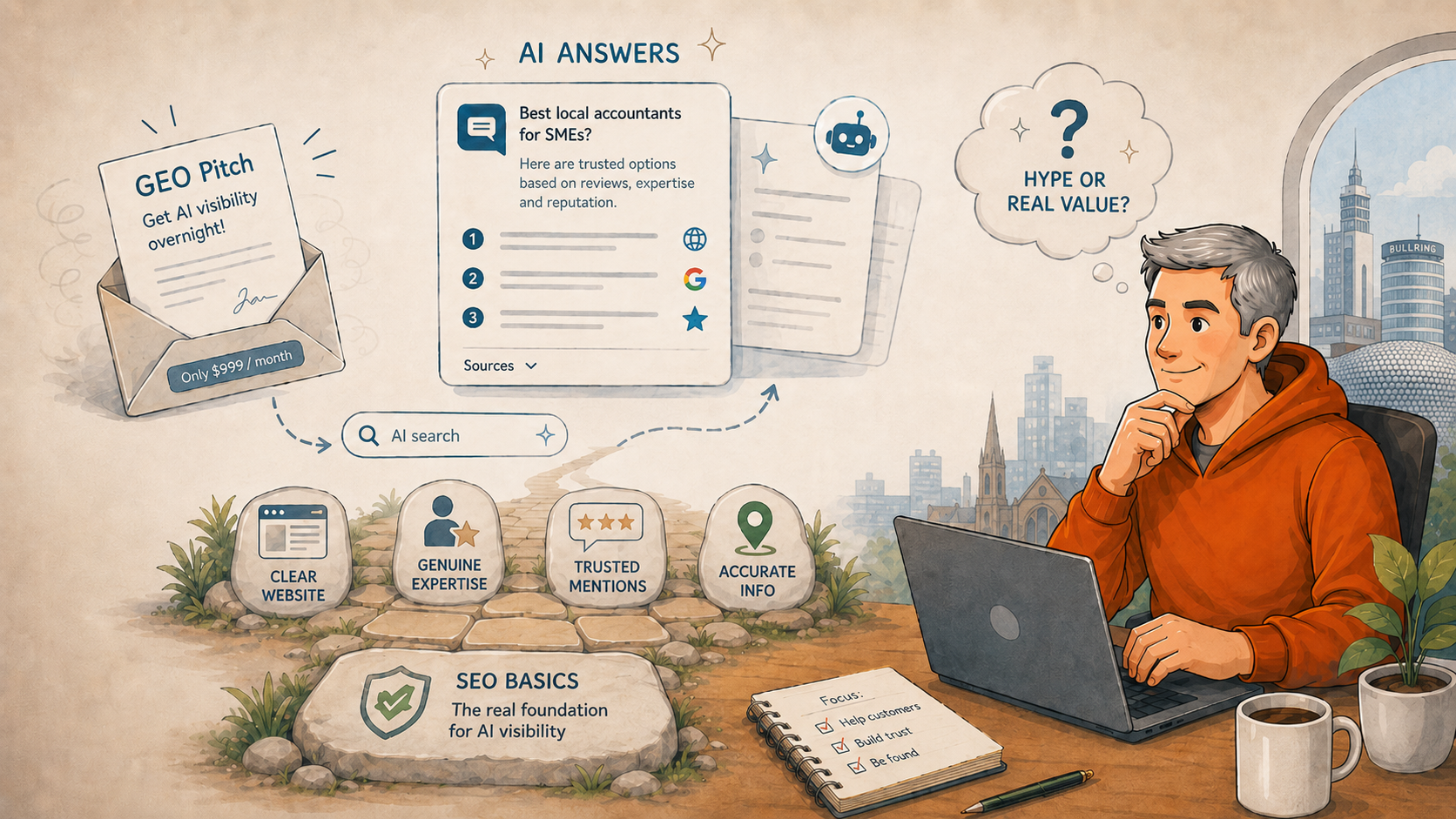
Somewhere in your inbox, now or soon, there'll be an approach along these lines. Search is changing, it will say. Your customers are asking ChatGPT rather than Googling. Traditional SEO is no longer enough. We can audit your AI visibility and make sure the AI tools recommend you, for a monthly fee.
GEO stands for Generative Engine Optimisation: getting your business mentioned when AI tools answer people's questions. The name deliberately echoes SEO, search engine optimisation, the long-established business of getting your website to show up on Google. And the pitch contains a kernel of truth, which is what makes it effective. Google now puts AI-generated answers on top of many results pages. Tools like ChatGPT, Perplexity and Google's AI Mode increasingly answer questions directly, citing a handful of sources rather than showing ten blue links. If an AI tool describes your industry to a potential customer and doesn't mention you, or describes you wrongly, that matters.
So the problem is real. The question is whether what's being sold to you is real too.
The short version, if you read no further. Most of what's sold as "GEO" is SEO you should already be doing: a clear, fast, well-structured website and genuine expertise. A smaller slice is writing and formatting your pages so they're easy to quote. And a tiny slice is genuinely new technical plumbing, the sort of thing your website platform increasingly handles for you, and rarely worth losing sleep over. The rest of this article is about telling those three apart, so that if an agency quotes you a monthly retainer, you know which one you're paying for.
One thing before we go on. If you already keep an eye on where your website visitors come from, this post will help you see what's shifting. But if you don't, perhaps because your customers mostly arrive by word of mouth, repeat business and referral, and you've never really looked at your search traffic, this matters to you more, not less. You're the person a GEO pitch is easiest to sell to, because you have no way to check the claims. So the aim here isn't to turn you into a data analyst. It's to give you enough to tell a fair offer from an expensive one.
How AI search actually works
Broadly, an AI answer may rely mainly on what the model already knows, or it may retrieve current information from the web, and increasingly it can combine the two. Google's AI Overviews draw on Google's live search systems; ChatGPT can automatically search the web when a question would benefit from current information, or answer without searching when it doesn't. When it answers without search, it is relying on what the model learned during training and subsequent updates, which may not include recent changes to your business.
The catch for smaller businesses is in that non-search mode. A large brand appears across the web thousands of times, so a model is more likely to have a rich learned picture of it. A ten-person firm might appear a handful of times, or not at all. So the characteristic failure isn't an AI reciting your old address, it's an AI knowing almost nothing about you and filling the gap with something plausible, or confusing you with a similarly named business two counties away. If you've ever watched an AI invent a service you don't offer, that's what you were seeing.
So there are two different ways to be visible, won by doing different things:
A citation is the AI crediting your page as a source: the link showing where the answer came from. To be cited, your page has to be found and judged worth using: largely a search problem.
A mention is the AI naming your business in the answer itself, for example, "firms like Yours Ltd are worth a look." A mention needs no link and may come either from information retrieved there and then or from associations the model learned during training. Either way, how you're described beyond your own website matters. That's closer to a reputation problem.
The two come apart in both directions, which is the useful part. You can be cited without being mentioned: your page is used as a source, but the answer never says your name. And you can be mentioned without being cited: the AI recommends you while linking to a directory instead. You want both, and any agency treating "AI visibility" as one undifferentiated thing hasn't thought about it hard enough. Running underneath both is a third question that gets too little attention: whether what the AI says about you is true. Being recommended is worthless if the recommendation carries the wrong phone number.
One sign this is real, not hype
Before my adviser life, I spent five years at Moz, whose Domain Authority score (a 1-to-100 rating of a website's clout) predicted how well a website will rank on search engine results pages. I'll declare my bias: it's favourable. What struck me there was the bar they set before shipping anything: does this genuinely help the customer, and can we stand behind the data? Moz built its name on metrics people quoted in boardrooms, and a number it couldn't defend was worse than no number at all.
That's why its move into AI visibility tracking registered with me. Measuring how often an AI mentions your business is genuinely hard; results move around, and the same question can produce different answers on different days. For a company whose reputation rests on trustworthy data, putting its name to a metric in that environment isn't a small decision. My read, from the culture I knew when I was there (and companies do change), is that they judged it both useful and defensible. That tells you something about where AI search has got to.
But notice what Moz didn't do. It didn't launch a new discipline. It added a new way of measuring to the same SEO toolkit. That's the whole argument of this article in a single product decision.
What the evidence says, and how fast it moves
The evidence here moves fast enough to embarrass everyone, including me: an earlier draft of this article carried a statistic that was already eighteen months out of date. So whenever a GEO sales deck quotes research, check the date.
The early evidence was comforting for SEO traditionalists. A late-2024 analysis of 120,000+ queries (Botify/DemandSphere) found around three-quarters of the links in Google's AI Overviews came from pages already in the top twelve ordinary results. If that were still true, GEO really would just be SEO in a new invoice.
It's no longer true. In March 2026, Ahrefs analysed 863,000 search terms and four million AI Overview citations and found only 38% now come from Google's top ten, down from about 76% a year earlier, with the rest split roughly evenly between pages ranking 11–100 and pages beyond 100. Part of that drop is Ahrefs simply detecting citations better than before (the sort of caveat a sales deck omits); part is real, and has a name: "fan-out", where AI systems break your question into many sub-questions and hunt for the best answer to each, reaching far deeper than a results page ever showed.
Rankings still matter, though. How much depends on the tool. For AI Overviews and Perplexity, which lean on the live search index, a strong ranking is a big advantage: one AirOps study found pages ranking first in Google were cited by ChatGPT about three and a half times more often than pages outside the top twenty. For ChatGPT answering from memory, the link to your Google position is far looser. Strong rankings remain one of the most reliable routes to being cited, just no longer the only one, or a guarantee.
And here's the part that matters most for a small business: the widening net is an opportunity. Under the old rules, if you couldn't outrank the big players you were invisible. Under fan-out, a page ranking fortieth can get cited if it's the clearest answer to one specific question. You don't need to beat the giants everywhere. You need to be the best answer to something.
There's independent evidence for this. Similarweb's March 2026 index of 113 major brands across six industries found the winners weren't the biggest but the most authoritative: in consumer electronics, a repair-guide site and two specialist camera dealers were mentioned more than their size would predict, outpacing far larger general retailers; in news, a specialist scientific database overachieved against household-name publishers. As Similarweb's own director of product marketing put it, authority, not just scale, is the differentiator. Two caveats: Similarweb sells AI visibility tracking, so read it as research from a company with something to sell; and these are large international brands, not UK SMEs; nobody has published equivalent research on small firms. But if depth of expertise beats size at the top of the market, that's the most encouraging thing a small specialist could hear. In UK terms: the trade supplier whose technical guides everyone quietly relies on, versus the national chain ten times its size. In AI answers, it's the guides that get read.
So how does a small firm build that authority?
This is the practical heart of the reputation problem, and the answer is encouraging. When AI tools handle broad discovery questions such as "best accountant in Worcester" or "who does X for manufacturers", they lean on trusted third-party sources: reviews, reputable publications, mentions in places that aren't your own website. (Several analyses suggest the large majority of what AI tools cite is third-party rather than a company's own site; they come from firms selling visibility tools, so treat the exact figures with caution, but the direction is intuitive: what others say about you counts for more than what you say about yourself.)
And the economics favour you. One credible mention, such as a quote in a trade publication, coverage of a local event or a comment on an industry story, can count for more than dozens of low-value paid listings. You don't need a press office. You need a handful of genuine, well-placed mentions, which AI tools then draw on to build their picture of who you are and whether you're worth recommending.
Where the money actually goes
So how does the work break down? The split below is my own rule of thumb, not a measured statistic. Nobody has published one, but it matches what the evidence keeps pointing at:
- About 80% is SEO you should already be doing. A fast, well-structured website. Clear pages that answer real questions. Genuine expertise. None of it new.
- About 15% is writing and formatting. Clear, direct content is easier for both people and AI systems to understand and use. Question-and-answer sections can be useful because they answer real customer questions directly; the point isn't to rewrite your site for AI, but to make genuinely useful answers easy to understand.
- About 5% is genuinely new housekeeping and measurement. Things like checking whether AI crawlers can access your public pages, understanding emerging conventions such as
llms.txt, and measuring whether you appear in AI-generated answers. Some of this is new; some is simply a new measurement layer on top of existing SEO.
When an agency pitches you GEO, ask which bucket you're paying for. The first used to be called SEO, and if you already pay for SEO, you shouldn't pay for it twice under a new name.
The 5% that's new: I flipped the switch on this blog
This blog runs on Ghost, and in mid-July Ghost added built-in GEO tools. Flick one toggle and your site starts publishing an llms.txt file, which you can think of as a contents page written for AI tools rather than people, plus a stripped-back, plain-text copy of every public post. Only public content is included, and it's off by default, because some publishers don't want AI tools ingesting their work at all.
That's a genuine trade-off, not an obvious yes. If your content is your product, you may have good reason to shut those automated readers out. But for most SMEs, your website exists to bring customers in, so if people are asking AI tools questions your website answers, you probably want the AI able to read it.
So I turned it on. Two minutes; no cost.
Now for the honest caveat: there's no solid public evidence that llms.txt improves visibility in the major AI search systems. Google now explicitly says that Google Search does not use llms.txt or other special AI text files for its generative search features. OpenAI and Anthropic have not publicly established llms.txt as a visibility signal either.
It's an emerging convention, not an agreed standard. OpenAI's published guidance for site owners, for example, focuses on crawler access through robots.txt, not llms.txt. Some specialists even compare it to the old meta keywords tag: website owners spent years diligently populating meta keywords in the hope that search engines would reward them, only for the major engines to eventually ignore the tag because it was easily abused and largely redundant compared with analysing actual page content.
Which is exactly why my position is this: I enabled it because it took two minutes and cost nothing. I wouldn't pay anyone a monthly fee for it. If your platform offers a similar switch, and especially if Ghost's move encourages others to follow, flip it yourself. Just don't buy it.
How do you measure any of this?
This is where GEO gets awkward, and where you should press hardest on anyone selling it. There's no public league table. The same question asked twice can give different answers from different sources, and results vary across tools. Anyone promising a precise "AI ranking" is measuring smoke.
But hard isn't impossible. What an SME can do, for free:
1. Run a monthly spot-check. Write down five to ten questions a customer might ask, in two kinds. Some naming you directly, such as "is [your company] any good" or "what does [your company] charge", to see how you're described. Others not naming you, such as "best [what you do] in [your area]", to see whether you surface in the category at all. That second, unbranded kind matters most: it tells you whether someone who's never heard of you would be pointed your way. Ask across two or three tools; note whether you're mentioned, cited, and described accurately. Twenty minutes a month gives you a trend line, and an AI getting your prices or location wrong is a problem to fix at source.
2. Ask new customers how they found you. Unfashionable, unbeatable, and it needs no software at all. "I asked ChatGPT" is starting to appear as an answer, and no dashboard beats hearing it directly.
3. If you track your website visitors, check where they come from. If you already use analytics, look for arrivals from chatgpt.com and perplexity.ai. The numbers will be small because AI answers keep people reading rather than clicking, but even a handful confirms you're being found. If you don't track this today, don't start a big project over it; the two checks above tell you most of what you need. Google has also added a dedicated Generative AI performance report to Search Console. I'm not going into that here because I'll come back to Search Console and Google Business Profile next month, but if you already use Search Console, it's worth knowing that this first-party data now exists.
4. Know what the paid trackers do before buying one. A wave of "AI visibility trackers" has arrived, from startups and established SEO platforms alike. They automate exactly the spot-check above: setting up your questions and recording your mentions over time, benchmarked against competitors. Useful, but they do nothing you can't do by hand with a spreadsheet. For a larger business, or one already seeing real numbers of AI-referred customers, a tracker from a reputable provider may earn its keep; established SEO platforms now increasingly include AI visibility tracking as we discussed, which tells you AI tracking is becoming standard rather than premium. For a typical SME, start with the free manual version, and upgrade only if your spot-checks show AI tools regularly mentioning or misrepresenting businesses like yours. Either way: results are volatile, so watch patterns over months, not daily scores.
Six questions to ask anyone selling you GEO
Don't argue about whether AI search matters. It does. Ask these instead:
- What will you do that isn't standard SEO? If the answer is "optimise your content and build authority", that's SEO with a new invoice.
- How will you measure success, in which tools, how often? Promises of precise rankings? Walk away. Mention rates, accuracy and trends over time? Keep listening.
- What did this same work cost when you called it SEO?
- Can you show me a client you've made visible in AI answers? Real prompts, real screenshots, real dates.
- What will you do about accuracy, not just visibility? Being mentioned is worthless if the details are wrong.
- Which parts could I do myself for free? An honest agency will tell you.
What to do this month (total cost: nothing)
- Ask two or three AI tools about your business and market, both ways: once with web search on, once in a plain chat with it off. The gaps differ: the first shows your findability, the second what lives in the model's memory.
- Make sure your website plainly states what you do, where, for whom, and at what rough cost. Clear beats clever.
- If you're a local business, check that your Google Business Profile is accurate and complete, particularly what you do, where you operate and how people contact you. Google now explicitly points to Business Profiles as one way local businesses can make their products and services visible in both AI responses and other Google Search results. I'm going to cover this properly next month, including how you can use Gemini to help review and improve your Google Business Profile, so for now just make sure the basics are right.
- Aim for one genuine third-party mention, such as a comment on an industry story, a local news tie-in or a trade-title quote, rather than a pile of paid listings.
- Check whether your platform has an AI-visibility toggle, like Ghost's. If it's free, consider flipping it, but go in with your eyes open about the uncertain benefit.
- Don't sign a GEO retainer this year unless those six questions produced convincing answers.
The direction of travel is real: more customers will get their answers from AI, and being findable there will matter more each year. But the businesses that win will mostly be the ones already doing the unglamorous work: clear websites, honest content, real expertise. That's been true through every wave of search for twenty-five years.
The label on the invoice changes. The work mostly doesn't.
Sources: Ghost changelog (16 July 2026); Google Search Central guidance on generative AI optimisation and Search Console Generative AI performance reporting (2026); OpenAI crawler guidance; Moz Pro AI Visibility notes (2026); Botify/DemandSphere AI Overviews study (late 2024); Ahrefs AI Overview citation analysis (March 2026, 863,000 terms); AirOps ChatGPT citation study (2026, 548,000+ pages); Similarweb Generative AI Brand Visibility Index (March 2026, 113 brands). Disclosure: the author worked at Moz for five years and has no current affiliation with the company. Figures were checked at the time of writing; in this field they date quickly.
A note on how this blog is made: I choose the topics, shape the message, and decide what matters for UK SMEs. I use AI as a working tool to support research, structure and drafting — but the judgement, interpretation and final sign-off are mine. Every post is reviewed, edited and approved by a real person before it is published.